The main events, from Morris’s revelations through the Montana congregations to later claimants and the present.
The movement at a glance
How the Morrisite congregations descended from one another, where many members went, and the later groups that drew on the tradition without descending from it.
Solid line: organizational succession or movement of members. Dashed line: a later claimant drawing on the Morrisite tradition.
1857–1862Joseph Morris, an English convert to the Latter-day Saint church, records the revelations later gathered as The Spirit Prevails. He writes repeatedly to Brigham Young. No written reply is known; Anderson reports that the first letter, dated December 7, 1857, bears a penciled note on its margin, “He’s weak minded.” The church’s answer comes in February 1861 (next entry).
11 Feb 1861The apostles John Taylor and Wilford Woodruff hold a meeting at South Weber to “regulate” the branch. On Taylor’s motion, seconded by Woodruff, sixteen of Morris’s followers are cut off from the church, among them Bishop Richard Cook, his brother John Cook, John Parson and Robert Farley (Woodruff’s journal, February 11, 1861). Morris’s name is not on the list Woodruff recorded.
6 Apr 1861Morris organizes the Church of the Firstborn and calls his followers to gather at Kington Fort, an abandoned 1853 settler fort at South Weber.
1861–1862The community holds its goods in common and awaits the Second Coming. As appointed days pass, some members grow discontented and try to leave.
11 Jun 1862Acting Governor Frank Fuller orders General Daniel H. Wells to furnish the territorial marshal, Henry W. Lawrence, and his deputies, Robert T. Burton and Theodore McKean, “a sufficient military force” to act as a posse in serving Third District Court writs for the arrest of “Joseph Morris and others residing in the northern part of Davis County.” The order survives in a copy Wells made in 1871 (Utah Territorial Militia Records, series 2210, document 1,215, Utah State Archives; page image on FamilySearch).
13–15 Jun 1862A territorial posse under Robert T. Burton besieges the fort. Morris and John Banks are killed during the surrender; eleven people die in all, including two young posse members, Jared Smith (June 13) and Peter Wahler (June 15).
18–19 Jun 1862Before Judge Kinney in Salt Lake City, Richard Cook is fined and jailed for contempt, Peter Klemgaard and Christian Neilson are held in prison, and ninety-five other men are bound over on $1,500 bail each for the March 1863 term (Deseret News, June 25, 1862).
Mar 1863In Salt Lake City, seven Morrisites are convicted of second-degree murder and sixty-six of resisting arrest. The new territorial governor, Stephen S. Harding, pardons them all three days later.
May 1863Many Morrisites leave Utah under the protection of Patrick Edward Connor, commanding the District of Utah. On May 5 a party of 160 (53 families, seven single men, and four widows) sets out with a company of California Volunteers; it reaches Soda Springs on May 20, where Connor has a town site surveyed on the north bank of the Bear River beside a new military post, Camp Connor (established by order of May 23). The Morrisites call their town Morristown. Connor also gives 150 Morrisites passage to Carson City, Nevada, in an empty supply train. Others settle in California. (Connor’s report, June 2, 1863, Official Records, ser. 1, vol. 50, pt. 1, 226–29.)
1860s–Some Morrisites return to the Church of Jesus Christ of Latter-day Saints, in Utah and elsewhere. The 2006 monument at South Weber notes that a few were rebaptized and remained there. Others find a home in the Reorganized Church (RLDS): the former Morrisite apostle Mark Hill Forscutt joins it in Salt Lake City in 1865, and John L. Bear (Johann Lebrecht Bär, 1838–1919), a Swiss convert from Affoltern am Albis who emigrated from Zürich in 1860 and lost his wife and child at Kington Fort, later serves as an RLDS missionary to Switzerland and Germany, dies in Independence, Missouri, and publishes his autobiography in the RLDS Journal of History. In 1865 RLDS missionaries at Malad, Idaho, baptize several people who appear on the roll. Others join only after years in the Morrisite groups: Erick and Caroline Eliason are baptized together at Soda Springs on June 9, 1870; Margaretta Cook leaves the Morrisites in Nevada in 1870 and is baptized RLDS in 1873; and Lena Hanson, at Soda Springs and then Deer Lodge, in 1895 (see the roll).
1867–1881William W. Davies leads a Morrisite offshoot, the Kingdom of Heaven, on Mill Creek near Walla Walla, Washington. He declares his infant son Arthur to be Christ returned, the “Walla Walla Jesus.” Lawsuits by former members end the community.
1869Danish-language congregations keep membership and account books in Omaha, Nebraska, and Council Bluffs, Iowa.
1870sMany members regather in the Deer Lodge Valley, Montana, under George Williams, the “Prophet Cainan,” who claims to be Morris's successor. In 1874 the Montana church is divided into two stakes.
1877Montana Morrisites begin building a wood-frame church a mile or so below Racetrack, south of Deer Lodge.
1879Robert T. Burton, indicted in 1870 for the killing of Isabella Bowman during the surrender, is tried and acquitted.
Jan 1879George Williams prophesies that Deer Lodge County will be the site of the Second Coming.
1880In Chicago, Mark Hill Forscutt, a former Morrisite apostle now serving as an RLDS minister, baptizes James Brighouse (August 5) and confirms him (August 8), having baptized Mrs. Brighouse in July and preached the funeral of their infant child. In December Forscutt nominates Brighouse as a teacher in the branch. (Forscutt journal, 1880–1881, Vault MSS 811.) Four years later Brighouse founds the Order of Enoch.
1882Williams dies, and the movement splits among rival successors. In Montana, where the church is known as the Church of Jesus Christ of Saints of the Most High, William James, its local president under Williams, is sustained in May 1882 over opposition, with Andrew Hendrikson and John R. Eardley as counselors. (Eardley, later a stake president, leaves Montana about 1900.) George Dove leads the California congregation.
1884A later claimant. James Brighouse, breaking from the RLDS Church, organizes the Order of Enoch in Independence, Missouri. The group rejects Brigham Young. Brighouse claims to be the “One Mighty and Strong” and a reincarnation of Christ and earlier prophets, a reincarnation teaching like that of the Davies group at Walla Walla. Wikipedia describes the Order as the one Morrisite-related body that survived 1969; its later activity has not been confirmed for this guide. Brighouse had been brought into the RLDS Church in 1880 by the former Morrisite apostle Mark Hill Forscutt (see 1880). One online account (Lost Mormonism) says the Order honored Morris as a prophet and martyr, but the standard references do not: Shields’s entry on the Order (Divergent Paths, 5th ed., §5.4) and Kraut’s note on Brighouse both omit Morris. Whether Brighouse drew on Morris, or Forscutt on Brighouse, remains open.
1886At a court meeting in the Lord’s House at Race Track, Montana, on May 10, George Thompson of London is elected president of the church; eleven members who decline to sustain him are given thirty days to do so. Thompson is probably the last general president. Andrew Hendrikson, a Danish immigrant who was never a Latter-day Saint, presides over the Montana Morrisites from 1886 until his death on July 3, 1921.
1886The Spirit Prevails, a collection of Morris's revelations, articles, and letters, is published by George S. Dove & Company.
1892In San Francisco, James Dove publishes A Few Items in the History of the Morrisites for the California congregation.
1921–1954George Johnson, Hendrikson’s associate of more than fifty years and likewise never a Latter-day Saint, presides at the Lord’s House until shortly before his death on April 29, 1954, at ninety-eight. Anderson calls him the last official Morrisite leader.
1969The Church of Jesus Christ of the Saints of the Most High, the last organized Morrisite body in Montana, formally disbands. According to Anderson, August 6, 1969, was the last annual Morrisite gathering. Its records, its descendants, and the Racetrack church remain.
1981–1988C. LeRoy Anderson publishes For Christ Will Come Tomorrow (1981) and Joseph Morris and the Saga of the Morrisites (1988), the first book-length histories.
1990A later claimant. Neal Chase, interpreter for Leland Jensen’s Missoula-based sect, the Bahá’ís Under the Provisions of the Covenant, publishes Ezekiel’s Temple in Montana. Drawing on Anderson’s book, he cites George Williams’s prophecy that Christ would come in the Deer Lodge Valley, identifies the Montana State Prison at Deer Lodge (where Jensen was held from 1969) as Ezekiel’s temple, and dates the fulfillment to August 9, 1969, Jensen’s first full day in prison. Anderson rejected this reading, noting that Williams named no date. The sect was not Morrisite in origin; it adopted Morrisite prophecies as confirmation of its leader’s mission.
1996–2010After Jensen’s death in 1996 the sect divides over leadership, with Chase leading one faction; lawsuits continue to about 2010.
2006A monument to the Kington Fort–Morrisite War site is dedicated at South Weber.
2010Anderson’s final edition, Joseph Morris and the Saga of the Morrisites (Revisited), is published.
July 2012Descendants of Morrisite families hold a reunion in Deer Lodge; the property owners allow them to visit the Racetrack church.
2026Kirk Watson publishes The Morrisites: Writings and Revelations, collecting writings of Morris, Williams, Davies, and the Doves. The Racetrack church still stands, in declining condition (see the condition record under Images).
History
Places
Sites connected with the movement, and what can be seen at each today.
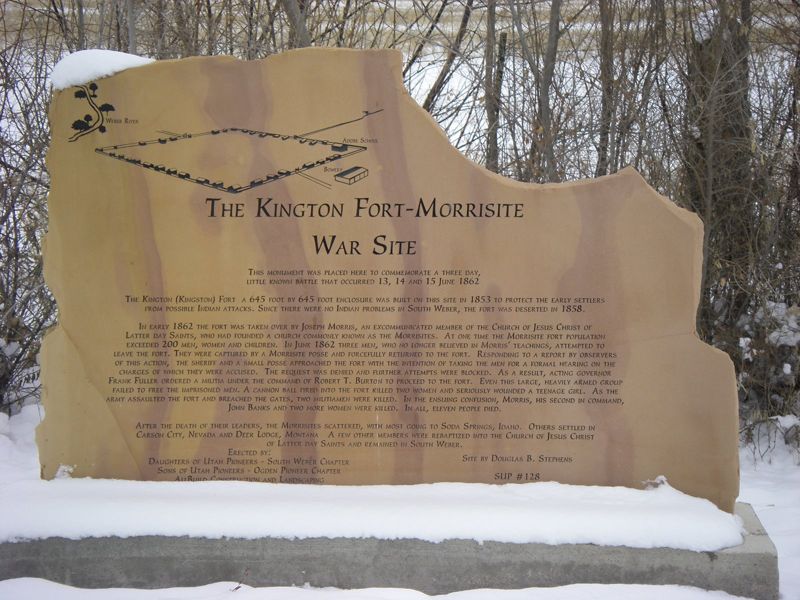
MO-IMG-001 · Monument, December 2008
Kington Fort
South Weber, Utah
Built in 1853 and abandoned in 1858, then reoccupied by the Morrisites. Nothing of the fort survives; a monument to the Kington Fort–Morrisite War site was dedicated in 2006. The fort was named for Bishop Thomas Kington, and “Kington” is the correct spelling. The monument itself notes that the earliest sources (the notebook kept by Kington’s wife, his gravestone, Wilford Woodruff’s journals, and early church records) all spell it that way; recent scholarship such as Holley (2008) follows them. Many nineteenth- and twentieth-century accounts, and some modern references, including the Utah History Encyclopedia and Wikipedia, write “Kingston Fort.” Insiders used both: Forscutt, who lived in the fort, wrote “Kingston’s Fort” and called it “the proper name” of the place (“Sketch of Joseph Morris,” CHL MS 702). Search under both spellings. A log cabin nearby, which the local historian Ed Cooper, from oral accounts of older South Weber residents, identified as the building Morris used to hold the three departing members whose detention led to the siege, is shown in MO-IMG-046–049; it has been moved from its original site, and the identification rests on local tradition. About 200 yards south, on the west side of the road, in the South Weber Pioneer Cemetery, a marker reads “Joseph Werner, ‘Morrisite,’ about 1870” (MO-IMG-021). The name lingered locally. In the early 2000s, while the editor was going door to door in South Weber, a woman then in her sixties said that elementary-school classmates had called her “Morrisite” as a taunt because of where in South Weber she lived; she said her family had no Morrisite connection. (Editor’s memorandum of recollection, written November 1, 2026; the conversation was not recorded at the time.) A cannonball from the siege was kept by the family of Al Peek, together with a portrait of Mary Christoffersen Anderson (MO-IMG-051–053; the portrait is MO-IMG-062).
VisitThe monument is public. The Pioneer Cemetery appears to lie on private land but is reached by a public easement; stay on the access route. The cabin is on private property.
MO-IMG-061 · Anderson gravestone, October 2018
Morristown
Soda Springs, Idaho
The Morrisites were among the founders of Soda Springs, one of the oldest towns in Idaho. Connor reported bringing 160 settlers (53 families, seven single men, and four widows), who arrived May 20, 1863, and were given building lots on a town site surveyed on the north bank of the Bear River, beside the military reservation of Camp Connor (Connor’s report, June 2, 1863, OR). A later marker describes a 200-acre survey west of Soda Creek, lots of 25 by 130 feet, and one-room log homes with dirt floors. The Morrisite “Lower Town” stood below the military “Upper Town”; Soda Springs was the first seat of Oneida County, 1864–66. After the troops left in 1865, hard winters and failed crops thinned the settlement. Many Morrisites moved on, some north to the Blackfoot area, and others sold to miners and to Latter-day Saint settlers, whose new town site dates from Brigham Young’s visit of 1870–71. Most of the old town now lies under Alexander Reservoir. Those who stayed, led by Niels Anderson, carried their quarrel with the Mormon hierarchy into territorial politics; the Niels Anderson Homestead marker credits his anti-polygamy campaign with helping deny Mormons the vote in Idaho. Accounts differ on some details: most give 160 settlers (one popular account says about 325), Camp Connor’s founding is dated May 20 or May 23, and the National Park Service marker wrongly calls Morris Welsh-born. Markers stand in town, including the Park Service’s Morrisite settlement marker in the parking lot of a Latter-day Saint meetinghouse (HMDB), the state’s Camp Connor marker (HMDB), and “Law & Order on the Frontier” on Camp Connor’s probable site near the hospital (HMDB). Descendants held a reunion in Soda Springs on August 3, 2013.
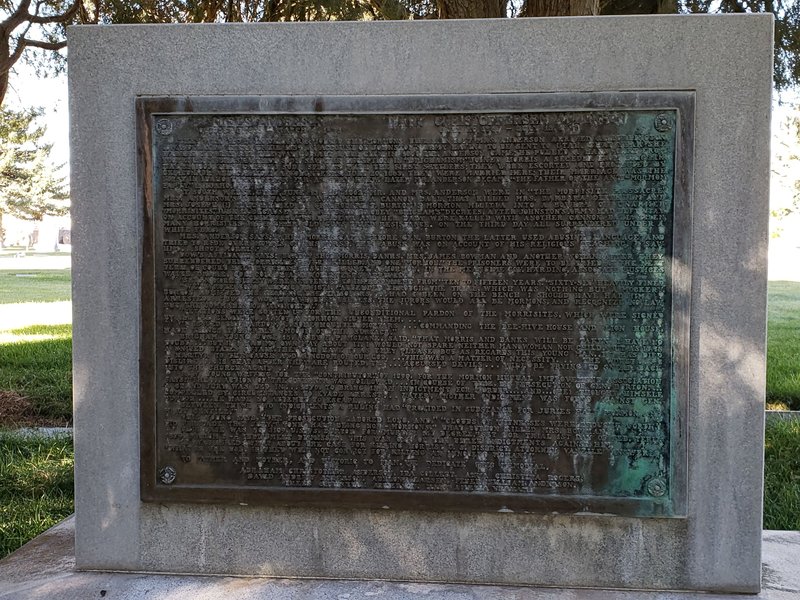
Niels and Mary Christoffersen Anderson, married at Morristown on July 20, 1863 (the date on their gravestone; some accounts give July 30), are buried in Fairview Cemetery at Soda Springs. Their gravestone carries a long bronze inscription giving a Morrisite account of the 1862 siege, in which Mary, then fourteen, lost her jaw to the first cannon shot fired into the fort. Forscutt, who was present, described her lower jaw “hanging only by a narrow strip of skin,” with two women dead beside her (“Sketch of Joseph Morris,” CHL MS 702; MO-IMG-061, with transcription; MO-IMG-062; HMDB; see also the Niels Anderson Homestead marker).
VisitThe markers and the Anderson gravestone in Fairview Cemetery are publicly accessible. The townsite is largely under Alexander Reservoir.
Carson City & California
Nevada · California
The western congregations, where George Dove published The Spirit Prevails and led the California church after 1882. In May 1863 Connor gave 150 Morrisites passage to Carson City in an empty quartermaster’s train bound there for stores (Connor’s report, June 2, 1863, OR).
VisitNo surviving sites identified for this guide. Information welcome.
Omaha & Council Bluffs
Nebraska · Iowa
Danish-speaking congregations whose 1869 membership and account books survive in translation.
VisitNo sites identified; the record survives in documents only.
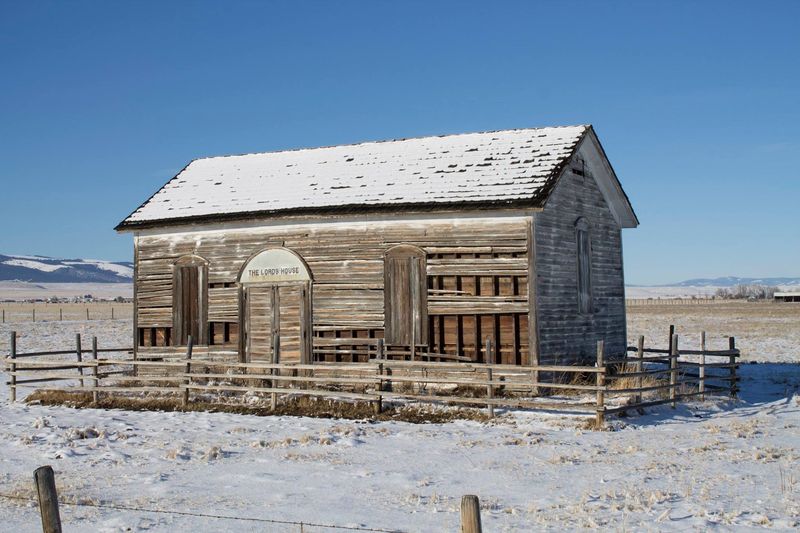
MO-IMG-014 · Racetrack church, November 2018
Deer Lodge Valley
Deer Lodge County, Montana
The longest-lived center of the movement. The wood-frame Morrisite church, begun in 1877, stood on private land at Racetrack, visible from the west side of Interstate 90 south of Deer Lodge, when last photographed for this guide in November 2018. Called the Lord’s House, as the panel over its doors reads, it was the church’s meeting place: George Thompson was elected president of the church there in 1886, and Andrew Hendrikson (1886–1921) and George Johnson (1921–1954) presided over the Montana church from it. It is the only Morrisite church building known to survive, and its condition has worsened markedly since 2009. See the condition record under Images.
View onlyThe church is on private land and unsafe. View it from the public road; do not enter or trespass.
Kingdom of Heaven
Walla Walla, Washington
William W. Davies's commune on Mill Creek, 1867–1881. A road called the Mormon Grade, an interpretive sign at Scenic Loop Road and Mormon Grade, and Davies's grave in Lyons Cemetery remain.
VisitThe interpretive sign and Lyons Cemetery are public.